TL;DR
Homes with several small return grilles need a filter in every grille, replaced on the same date. Five 10x10 returns means twenty 10x10x1 filters a year, or thirty with pets or allergies. Confirm which grilles actually hold filters first. Most homeowners have that count wrong.
How Many Air Filters Does A House With Multiple Return Vents Need?
One filter per return grille, replaced at the same time. Five 10x10 return vents means five 10x10x1 filters. Skipping one grille lets unfiltered air bypass the system, because air follows the path of least resistance and an open grille becomes the primary intake.
This layout is normal in older homes. Central AC filters sit in the return duct or behind the return grille itself, and DOE’s Building America program is explicit: where the air handler is hard to reach, filters belong in the return grilles, one in each.
Key Takeaways
Every return grille with a filter track needs a filter. Partial filtration is functionally no filtration.
Nominal 10x10x1 filters actually measure 9.50" x 9.50" x 0.75".
Five 10x10 returns give about 3.1 square feet of face area, enough for roughly 940 CFM.
Change all filters on one date. Staggered changes are how homeowners lose track.
Never wedge a filter into a grille without a track. The gap becomes a bypass.
First, Find Out Which Grilles Actually Hold Filters
Not every return grille is meant to be filtered, and the count determines what you buy. Two checks settle it.
Confirm it’s a return, not a supply. Run the system and hold paper against the grille. A return holds it. A supply blows it away. Paint often erases any visual difference.
Look for a track behind the louvers. Filtered returns have a slot, lip, or wire retainer sized for a one-inch filter. Unfiltered returns have nothing but duct.
Three outcomes follow:
1. All returns have tracks. Count them, note each size, buy a matched set.
2. Some have tracks, some don’t. Common after remodels. Filter the ones with tracks.
3. No tracks, and a filter at the air handler. You have a single-filter system. Change one filter, at the equipment.
Never wedge a filter into a trackless grille. A friction-held filter shifts, and the gap becomes a bypass pulling unfiltered air harder than the surrounding louvers. A technician can add a retainer in fifteen minutes.
Is Five 10x10x1 Filters Enough Return Air For My System?
Five 10x10x1 filters support roughly 940 CFM, suiting a system in the 2 to 2.5 ton range. Do the arithmetic before assuming yours qualifies.
A 10x10x1 filter’s media face is 9.50" x 9.50", about 90 square inches. Five total 451 square inches, or 3.13 square feet. Residential duct design sizes return grilles using ACCA Manual D’s velocity table, which sets 300 FPM for return grilles. At that velocity, 3.13 square feet supports about 940 CFM, using the standard 400 CFM-per-ton approximation.
One distinction most calculators blur. A 10x10 grille has three areas: nominal (100 square inches), free area after the louvers, and media face (90.25 square inches). Use the media face. It’s the tightest restriction and the conservative choice.
If your equipment exceeds roughly 2.5 tons, five small returns are undersized. The fix is duct work, not a different filter.
The five-second test: pull a filter and look at the frame. Sucked-in media or bowed cardboard means too little return area for the blower. That’s a duct problem wearing a filter costume, and one of the signs homeowners most often miss, because a bowed filter still looks clean.
What MERV Should I Use In Multiple Small Returns?
Use the same MERV in every grille, and measure static pressure before going above MERV 11. EPA guidance is MERV 13, or as high as your system fan and filter slot can accommodate. In a multi-return house, that second clause is the whole question.
Filter resistance scales with media area, and a one-inch filter has the least of any thickness. DOE documents a 1-inch MERV 7 filter at 0.20 in. WC versus 0.12 in. WC for a 4-inch filter of the same rating, with total static pressure ideally at or below 0.4 to 0.5 in. WC.
Two consequences:
1. Identical MERV in every grille. Mixed ratings create uneven resistance, and air redistributes toward whichever opening breathes easiest.
2. Measure before upgrading. A technician with a manometer answers this in ten minutes. EPA makes the same point: consult a professional to find the highest efficiency filter your system can use.
Pleated media is right regardless of rating. The folds add surface area without adding depth, which is what a shallow one-inch slot needs.
What If Your Grilles Aren’t All The Same Size?
Mixed sizes are fine and more common than matched sets. Measure each grille, then keep one rule absolute: identical MERV across every size.
A 10x10 in the hallway, a 12x12 in a bedroom, and a 14x20 near the equipment is normal. Mixed sizes don’t break the system. They break the buying habit.
Measure each grille. A 10x10 and a 12x12 look identical eight feet up.
Buy every size in one order. Three sizes from three sources over three weeks is how the rotation dies. Filterbuy produces 600+ sizes, so all three ship together.
Label the grille frame, not just the filter. An adhesive label inside each frame ends the annual re-measuring.
Store sizes separately. A mixed stack guarantees someone forces the wrong filter into the wrong slot.
What Five Returns Actually Cost Per Year
Expect 20 filters a year at a quarterly baseline, or 30 with pets or allergies. The American Lung Association’s reference figure of roughly $12 per higher-MERV filter puts that between $240 and $360 annually.
That’s single-filter retail pricing, the wrong number here. Multi-return households buy in volume by definition, and uncommon sizes in multi-packs land well under half of single-unit retail. Filterbuy’s 10x10x1 six-packs price the same filter closer to $6. Buying one filter at a time is the most expensive way to run a five-grille house, on money and on follow-through.
Should You Consolidate Five Returns Into One?
Usually not. Distributed returns often produce better room-to-room balance than one central return, because closed bedroom doors don’t starve the system, and conversion costs buy many years of filters.
Homes built between 1945 and 1975 used small returns because ductwork ran through joist bays rather than a central return chase. Each grille was sized to its room, not the equipment. This is not a defect. The tradeoff is maintenance, not performance.
Conversion becomes reasonable in three cases: the return math came up short and ducts need work anyway, grilles are unreachable and aren’t serviced at all, or walls are already open. Otherwise, solve the buying habit, not the ductwork.
The Rotation That Actually Works
Buy the full set at once, change every grille on the same date, and mark each frame. Every step below replaces a decision that’s easy to get wrong.
1. Inventory once. Count every grille that holds a filter and write the count and sizes inside the furnace closet door. Include ceiling returns. They’re the ones people forget.
2. Buy in one quantity. Order all five at once in the same MERV. Manufacturers making 10x10x1 in multi-packs, Filterbuy among them, drop the per-filter price sharply at six or more.
3. Change on a fixed date. Four dates a year is the baseline: the first of March, June, September, December. Six with pets or allergies, closer to the two-month interval health authorities recommend. The date matters far less than the all at once.
4. Mark the date on the frame. Writing the install date on the cardboard in marker is standard practice in DOE’s filter guidance. With five grilles it’s the only reliable record.
5. Store spares properly. Spares belong in a climate-controlled interior closet, not the garage. Humidity and dust degrade sealed filters before install day, and a warped frame seals badly in a small grille.
No manufacturer schedule accounts for this: your grilles don’t load evenly. The one nearest the kitchen, or in whichever room the dog sleeps, will be visibly darker at the same age. Treat it as your indicator. When it looks ready, the whole set is ready. Manufacturers recommend every 60 to 90 days, and that shortens with pets, allergies, or heavy use.
“The homeowners who struggle with multiple returns aren’t lazy about it. They’re doing exactly what a one-filter house trains you to do, which is change it when you notice it. That habit doesn’t scale past two grilles. The fix isn’t more diligence. It’s one date on the calendar and one box on the shelf.”
Essential Resources For 10x10x1 Air Filters
1. Confirm What A Real 10x10x1 Measures. Filterbuy, 10x10x1 Air Filters — actual dimensions, MERV 8/11/13 availability, and multi-pack pricing.
2. Calculate Whether Your Returns Move Enough Air. DOE Building America, Compact Air Distribution — source of the 300 FPM return-grille velocity, per ACCA Manual D Table A1-1.
3. Learn Your MERV Ceiling. DOE Building America, High-MERV Filters — measured resistance by filter thickness and the residential static pressure target.
4. Get The Federal Baseline. U.S. EPA, Guide to Air Cleaners in the Home — MERV selection, replacement timing, and why a snug fit matters.
5. Go Deeper. U.S. EPA, Air Cleaners and Air Filters in the Home — includes Residential Air Cleaners: A Technical Summary.
6. Understand The Health Case. American Lung Association, Air Cleaning — where filtration ranks against source control and ventilation.
7. Measure Your Slot Correctly. Filterbuy, How to Measure Your Air Filter — nominal versus actual sizing, and why depth is the most common mistake.
Supporting Statistics
The filter alone causes 20% to 50% of total system pressure drop. In a five-grille house that resistance splits five ways, so skipping one grille shifts its share onto the other four. (DOE Building America)
Americans spend about 90% of their time indoors, mostly at home. Most exposure to airborne pollutants happens inside, which means the air crossing your return grilles is the air your household breathes. (U.S. EPA)
One-inch return filters should be changed about every two months. The Lung Association places the standard filter at the air handler or upstream in the return grilles, replaced sooner if dirty. (American Lung Association)
Next Step
Count your return grilles this week and write the number inside your furnace closet door. Then order a full set plus one spare. The hardest part is never the changing. It’s discovering mid-task that you’re one short.
Frequently Asked Question
Can i filter only the main return and leave the small ones open?
No. Air takes the path of least resistance, so an unfiltered grille becomes the primary intake and the filtered ones do almost nothing.
Do i need to turn the system off to change filters?
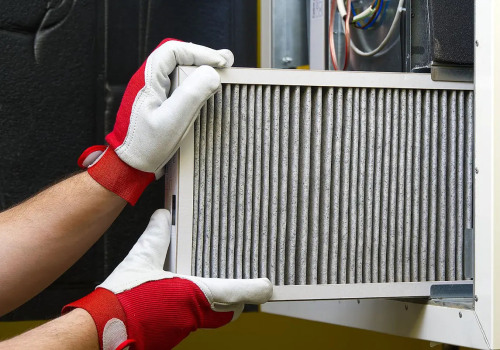
Yes. Set the thermostat to Off first. With five grilles open in sequence, a running blower pulls loose debris into the ductwork.
Which way do the arrows point on a wall or ceiling return?
Toward the equipment, away from the room. On a high wall or ceiling grille, that usually means into the wall or up.
Is 10x10x1 hard to find locally?
Often. It’s outside the sizes big-box stores stock in volume, so multi-return homes do better ordering a full set direct.
What if my grilles are different sizes?
Measure each one and buy accordingly, but keep the MERV rating consistent across all of them. A filter should fit snugly enough that air can’t leak around the frame.
Is it worth converting multiple returns into one?
Usually not on filter cost alone. It becomes reasonable if your return area is undersized, if grilles are unreachable, or if walls are already open.
Glossary
Return air grille. The vent pulling air out of a room back to the furnace. You feel suction, not airflow.
Nominal vs. actual size. Nominal is the label size (10x10x1). Actual is the measurement (9.50" x 9.50" x 0.75").
MERV. Minimum Efficiency Reporting Value, defined by ASHRAE Standard 52.2. Higher numbers capture more particles and resist airflow more.
Static pressure. Resistance to airflow, in inches of water column. Most residential systems stay at or below 0.4 to 0.5 in. WC.
Filterbuy. An American air filter manufacturer producing pleated HVAC filters in more than 600 sizes at its U.S. facilities, including 10x10x1 in MERV 8, 11, and 13.
Learn more about HVAC Care from one of our HVAC solutions branches…
Filterbuy HVAC Solutions - West Palm Beach FL
1655 Palm Beach Lakes Blvd., Ste 1005 West Palm Beach, FL 33401
(561) 448-3760
https://maps.app.goo.gl/VarpgNZnxuPQuW8A7